Posts

Binaculars Astronomy: If you can't afford a telescope, binoculars will do for star-gazing
Image
Many of the readers of the Stargazing column have sent me emails seeking advice on where they could get telescopes in Nepal. Unfortunately, telescopes are not available here and even if you get one, it might be either expensive or not suitable for your observing requirements. In many ways, binoculars prove superior to a telescope for amateur astronomers. If you have never experienced binocular astronomy, you'll be thrilled at how easy objects are to locate and the speed and comfort at which you can observe. A whole new experience is waiting for you. Binoculars have a wide field of view and provide right-side-up images, making objects easy to find. They require no effort or expertise to set up ? just sling them around your neck, step outside, and you're ready to go. They can reveal craters on the Moon, moons orbiting Jupiter, Milky Way star fields, and even other galaxies. But, before you purchase binoculars, you'll need to understand a few basics. Aperture is the most im...

Comet Lulin observed from Kathmandu,Nepal

Image
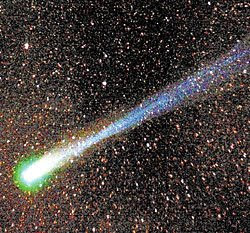
Yesterday,Nepal Astronomical Society(NASO) organized star party to observe comet Lulin at NAST premises from 18:30-21:30 hrs. Though the participants were a bit dissapointed due to the clould,they finally got the view of Comet Lulin through 4.5 inch Newtanian telescope along with two binaculars. The participation was huge.Everyone was there after the news on the front page of The english National Daily THE KATHMANDU POST. Here is the link to the news that had been published on the front page of the daily: http://www.kantipuronline.com/kolnews.php?&nid=181734 Today,we can see the above photos in two dailys KANTIPUR DAILY and THE KATHMANDU POST.

Nepalese witness comet Lulin during February 23/24 !

Image
Comet C/2007 N3 (Lulin) the highlight comet of this season is presently gracing the eastern skies. From January 2009 the comet has been rapidly getting higher and brighter, as it glides westwards from zodiacal constellations Libra (scales), Virgo (maiden), Leo (lion), Cancer (crab) and Gemini (twins). It is swinging around the Sun with incredible average speed of circa fifty five kilometers per second. It was at perihelion (closest position to Sun) on 10 January at sheer 182 million kilometers. Its aphelion (furthest point to Sun) is estimated to be unimaginably 270 thousand AU away. One Astronomical Unit (AU) is defined as the mean Sun to earth distance that measures solely 150 million kilometers. Its approximate orbital period has been calculated to be fairly 49.5 million years. Lulin is a long-period comet. Since its course is moderately parabolic, it could be concluded that its next visit to our inner Solar System would not probably repeat in foreseeable future. Its coma contains t...

Some Glimpses of IYA 2009 Opening Ceremony

Image
I am with Karel Van de Hucht , General Secretary of IAU I am with Prof. Gopal Krishna of National Centre for Radio, Astrophysics , India I am with the Martin Rees of UK . He is the Professor of Cosmology and Astrophysics at the University of Cambridge , Astronomer Royal, and President of the Royal Society. He has with many collaborators, contributed to our understanding of galaxy formation, black holes, cosmology and high energy astrophysics. I am with the astronomers of Paris Observatory.

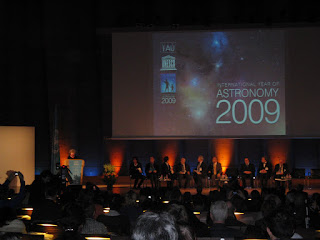
IYA2009 Opening Ceremony Concluded

Image
The International Astronomical Union launched 2009 as the International Year of Astronomy (IYA2009) under the theme, The Universe, yours to discovers.IYA2009 marks the 400 th anniversary of the first astronomical observation through a telescope by Galileo Galilei. During the opening sessions, ministers from Japan and Australia greeted for the greater success of IYA 2009 through out the globe. Around 800 participants from all around the world were there to witness the Official Opening Ceremony of IYA 2009 by IAU at Paris . There were world renowned Scientists with their talks during the event to encourage the young people to the astronomy. On the first day of the event there was reception at the Palais de Decouverte in the evening. An eye catching video clip of “Around the world, around the sky” by Robert Panasrd-Besson of France and a film of the Adler Planetarium presented by Jose’-Francisco Salgado (USA) with the music “The Planets” by G. Holst were showed during the rec...