Posts

Wish you all a happy Blue Moon August 2012

Image
I would like to wish all my valued reader a Happy Blue Moon tonight. A blue moon can refer to the third full moon in a season with four full moons. Most years have twelve full moons that occur approximately monthly. In addition to those twelve full lunar cycles, each solar calendar year contains roughly eleven days more than the lunar year of 12 lunations. The extra days accumulate, so every two or three years (7 times in the 19-year Metonic cycle), there is an extra full moon. Lunisolar calendars have rules about when to insert such an intercalary or embolismic ("leap") month, and what name it is given; e.g. in the Hebrew calendarthe month Adar is duplicated. The term "blue moon" comes from folklore. Different traditions and conventions place the extra "blue" full moon at different times in the year. In the Hindu calendar, this extra month is called 'Adhik (extra) masa (month)'. It is also known as purushottam maas, so as to give it a devotion...

AstroFest on ToV2012-Nepal, July 4-6,2012

Image
Nepal Astronomical Society (NASO) in association with Nepal Academy of Science & Technology (NAST), Russian Center of Science & Culture ( RCSC), Astrophysics and Cosmology Research Group Nepal ( ACRG-Nepal) -Tribhuvan University ( TU) and ESPRO Foundation organized three days Astronomy Festival with different programs in Nepal during June 4-6 , 2012 to celebrate the last Transit of Venus of Twenty-first Century. The next Transit of Venus will occur after 105 years in December 2117. To provide more opportunity for Nepalese to witness this rare celestial event in different regions of Nepal, NASO extended its supports to Pokhara Astronomical Society (PAS) in Kaski, Damak Astronomy Club in Jhapa and Nepal Astronomy and Space Science Association (NASSA) in Chitwan. GTTP Session: A half day workshop was organized on June 4, 2012 from 11:30 am to 2:00 pm as a special session on Galileo Teacher Training Program (GTTP)-Nepal. This special session of AstroFest on ToV2012-Nepa...

B.A.G. Brothers Donates Scientific Instruments to Central H.S. School for The Deaf, Kathmandu!

Image
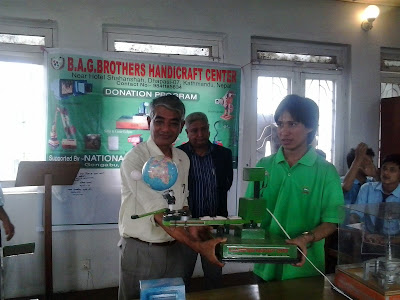
On Wednesday, July 4, 2012, I had an opportunity to interact with the students of Central Higher Secondary School for The Deaf, Naxal, Kathmandu,Nepal. This opportunity was provided by B.A.G. Brothers Handicraft Center, Kathmandu, Nepal. The Center had planned to donate the scientific equipments it has been producing and marketing in Nepal since 2009. The Center donated scientific equipments of worth ~50,000 NRs to the school during the donation program. Mr. Bijay Shahi donating the equipment to Mr. Narayan Bhakta Shrestha, Principal of the school.    Mr. Bijay Shahi, who makes the astronomical modules, demonstrated the instruments to the students. During the program, Mr. Shahi explained that they planned to donate those sets to at least one school per year to motivate students to do science with our own materials. He also expressed that the center will gradually make its product more scientific with its accuracy with the support of Nepal Astronomical Soc...

Call for Participation:The 1st SEAYAC Meeting will be held on November 5-9, 2012 in Puerto Princesa City, Palawan, Philippines

Image
South East Asian Young Astronomer Collaboration ( SEAYC) has announced it's first meeting that will be held in Philipines during November 5-9, 2012.  The aim of the SEAYAC Meeting is to gather young astronomers (undergraduate, graduate and early post-docs) who are conducting research in astronomy and to provide a venue where they can present their work. To get more updates of the meeting, please feel free to visit the SEAYC webpage:  http://seayac.org/ You can get all the travel information from the official website of Consulate General of Republic of Philippines in Nepal:  http://www.voith.com.np/philcongen/ Southeast Asian Young Astronomers Collaboration or SEAYAC is a group for young astronomer in South East Asian Region. The main objective of SEAYAC is to encourage interaction and collaborations between young astronomers from all Southeast Asian nations.  Being a relatively new field in Southeast Asia, it is important that young astronome...

Find An Asteroid Search Campaign & Move An Asteroid 2012 Competitions of SGAC

Image
The Near Earth Object Working Group ( NEO-WG) of Space Generation Advisory Council (SGAC) has announced two important competitions. 1. Find An Asteroid Search Campaign in collaboration with IASC (http://iasc.hsutx.edu). It has slots for 10 - 15 teams, with 3 - 5 individuals each, to participate in an Asteroid Search Campaign. No previous knowledge is required and participants have the chance to discover an asteroid! Application deadline June 1 . While teams can be made up by individuals from around the world, SGAC would also like to see some regional or national teams, (e.g. Team Kiwi, Team UK, Team Latinamerica, etc.). That is where you come in! As you can imagine, this is a great outreach opportunity in your country, try to make the best of it. While doing so, please don't forget to spread the word about our other competition as well: 2. Move An Asteroid 2012 Technical Paper Competition - for the 5th year in a row, SGAC is looking for novel ideas with regard to asteroi...

Supermoon washes this year's Eta Aquarid Meteor Shower!

The annual Eta Aquarid meteor shower is expected to peak this weekend. The mornings of May 5 and 6, 2012 are probably best for meteor-watching. But the largest full moon of 2012 on May 5 will drown these meteors in its glare. When no moon is in the sky to spoil the show, you typically see 10 to 20 meteors per hour at mid-northern latitudes and perhaps twice that number in the Southern Hemisphere, for the Eta Aquarid shower. This shower is like most others in that the best time to watch tends to be during the wee hours before dawn. he Eta Aquarid meteors, in particular, are strictly for night owls or early risers, if you’re in the Northern Hemisphere. This shower’s radiant point doesn’t rise over our horizons until around 2 or 3 a.m. The meteors are few and far even then, but the wee hours are a time for catching earth-grazing meteors in this shower. An earth-grazer is a long, slow, colorful meteor that horizontally streaks the sky. The closer to dawn, the more Eta Aquarid meteors you’r...

Congratulations Yael Naze!

Image
I am very happy to know Dr. Yael Naze has won the EuroPlanet Outreach Award 2012 for her extraordinary involvement for astronomy outreach in different communities. You can find the full stay here . Congratulations Yael, looking forward to hear more good news in coming days :)